
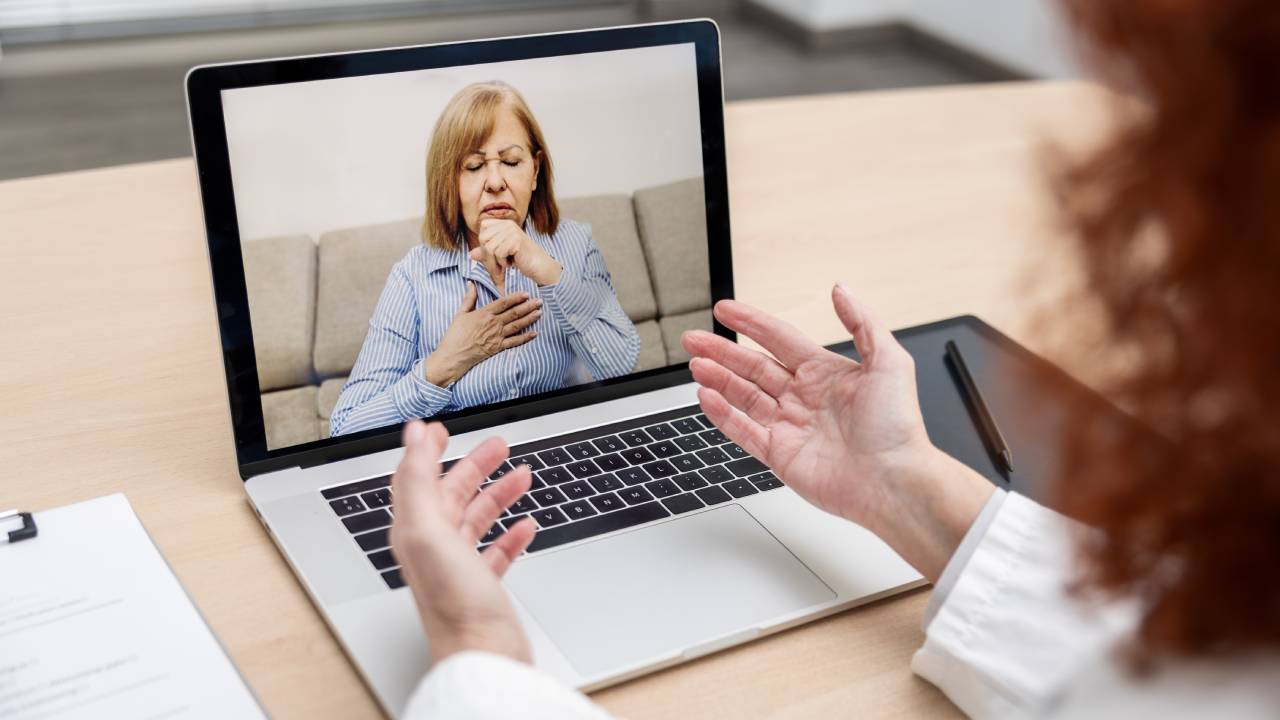
Telehealth therapy in Iowa has become one of the most practical ways to access licensed mental health care, whether you live in Des Moines, a rural county with no local providers, or anywhere in between. This guide covers exactly how it works, who it serves, what your insurance covers, and how to move from reading about it to actually booking an appointment.
What Telehealth Therapy Actually Is
Telehealth therapy is licensed mental health care delivered through a secure video call, phone session, or messaging platform instead of a traditional office visit. The clinical credentials are identical. The treatment approaches are the same. The only difference is the medium.
Iowa has expanded telehealth access significantly since 2020. According to the Iowa Department of Public Health, telehealth utilization across the state increased by more than 4,000% between 2019 and 2021, with mental health services accounting for the largest share of that growth. That trajectory has held. For a state where roughly 60% of counties have a mental health professional shortage, telehealth is not a convenience feature. It is the access point.
How Telehealth Therapy Works in Iowa
The mechanics are straightforward. You schedule an appointment with a licensed provider, receive a secure link to the session platform, and connect from wherever you are. No special equipment is needed beyond a smartphone, tablet, or computer with a reliable internet connection. Most sessions run 45 to 55 minutes, follow the same therapeutic structure as in-person visits, and are documented in your clinical record exactly the same way.
A 2022 meta-analysis published in the Journal of Affective Disorders reviewed 17 randomized controlled trials and found no statistically significant difference in therapeutic outcomes between video-delivered therapy and in-person therapy across anxiety, depression, and PTSD presentations. What this means in practice: you are not settling for a lesser version of care when you choose telehealth. You are choosing a different delivery format for the same intervention.
What to Expect in Your First Session
Your first session is an intake appointment. The provider gathers your mental health history, identifies your primary concerns and treatment goals, and discusses session frequency going forward. Most practices handle all paperwork and consent forms digitally, so you complete them before the appointment ever begins. The practical move here is to fill out your intake forms the evening before, not the morning of. Rushing through clinical history documentation twenty minutes before a session affects the quality of the information you provide, and your provider needs that information to build a useful treatment plan.
Technology Requirements and Privacy Protections
Telehealth platforms used by licensed providers must comply with HIPAA, the federal law governing health data privacy. What this means in plain language: the video platform encrypts your session data end-to-end, stores no recordings without your explicit consent, and is purpose-built for clinical use. Standard consumer apps like FaceTime or personal Zoom accounts are not HIPAA-compliant and are not used for telehealth therapy by licensed providers.
Before booking with any provider, confirm the platform they use. HIPAA-compliant telehealth platforms include Doxy.me, SimplePractice, and Therapy Brands products. If a provider does not list their platform, ask directly: “What video platform do you use, and is it HIPAA-compliant?” Any reputable practice answers that question immediately.
Who Telehealth Therapy in Iowa Helps
Telehealth therapy serves adults, teens, couples, and families across Iowa dealing with anxiety, depression, trauma, ADHD, bipolar disorder, autism spectrum concerns, relationship challenges, co-occurring disorders, and substance use. The breadth of that list is not marketing. It reflects what outpatient mental health care actually covers.
The gap in access it closes is well-documented. According to SAMHSA’s 2023 National Survey on Drug Use and Health, approximately 57% of adults in Iowa with a mental illness received no mental health treatment in the previous year. Geographic isolation and provider shortages in rural counties account for a significant share of that unmet need. Telehealth removes the distance variable entirely.
Adults Managing Anxiety, Depression, and Trauma
Evidence-based modalities including Cognitive Behavioral Therapy, EMDR, and trauma-focused approaches translate effectively to the telehealth format. A 2020 study published in Psychiatric Services examined CBT delivery across 344 veterans and found that telehealth-delivered CBT produced equivalent reductions in PTSD symptom severity compared to in-person delivery, with higher session completion rates in the telehealth group.
A typical 8 to 12 week treatment arc for anxiety or depression delivered remotely looks like this: weekly 50-minute sessions in the first month to establish a working relationship and baseline, followed by skill-building sessions using structured CBT frameworks, then a gradual shift toward biweekly appointments as symptoms stabilize. If you are dealing with anxiety, depression, or trauma and want to understand your starting options, the format itself is not the variable that determines outcomes.
Teens and Young Adults
Telehealth reduces the friction that keeps teenagers out of care. There is no transportation dependency, no waiting room where a classmate might see you, and no unfamiliar clinical environment. Teenagers already conduct most of their lives through screens. A therapy session on a familiar device in a familiar room lowers the activation barrier considerably.
A 2021 study in JAMA Pediatrics examined telehealth engagement among adolescents aged 13 to 17 and found that appointment attendance rates were 19% higher in telehealth formats compared to in-person equivalents, particularly for first-time therapy recipients. If you are a parent trying to start this conversation with a teenager, the most effective approach is direct and low-pressure: frame the first session as a conversation, not a commitment to ongoing treatment. Most teenagers who show up for one session continue.
Couples and Families
Joint sessions work cleanly in telehealth formats. Both partners connect from the same device or from separate devices if they are in different locations. Most HIPAA-compliant platforms support multi-participant sessions without any additional setup. The logistics matter less than the environment: you and your partner should be in the same private space when possible, with no other household members present during the session.
A 2021 study in Family Process reviewed outcomes across 200 couples who completed 8 or more telehealth couples therapy sessions and found no significant difference in relationship satisfaction outcomes compared to in-person therapy benchmarks. The practical step before your first couples session is to identify a single private room in your home, communicate to other household members that the space is unavailable for 60 minutes, and silence shared devices other than the one you are using for the session.
Individuals with Co-Occurring Disorders and Substance Use Concerns
Co-occurring disorders, meaning the simultaneous presence of a mental health condition and a substance use disorder, are more common than the healthcare system’s fragmented treatment model suggests. SAMHSA’s 2022 data indicates that 9.2 million adults in the United States live with co-occurring disorders, and fewer than 7% receive integrated treatment that addresses both simultaneously.
Integrated treatment for co-occurring conditions is available via telehealth in Iowa. When contacting a provider, ask directly: “Do you provide integrated treatment for co-occurring mental health and substance use conditions, or will I need separate providers?” A practice equipped to handle both will answer that question without hesitation.
Iowa Insurance Coverage and Medicaid Access
Iowa has telehealth parity protections in place. Under Iowa Code and regulations aligned with federal telehealth expansion guidance, insurers are required to cover telehealth mental health services at the same reimbursement rate as equivalent in-person services. This applies to private insurance plans and to Iowa Medicaid.
For Medicaid-insured individuals, this matters significantly. Medicaid recipients have historically faced the sharpest access barriers: limited provider panels, geographic concentration of accepting providers, and cost unpredictability. Telehealth parity removes the geographic restriction entirely, and Iowa Medicaid coverage of telehealth therapy means cost-per-session remains consistent with in-person rates under your plan. If you want a full breakdown of what Medicaid covers for outpatient mental health in Iowa, the details are worth reviewing before your first call to a provider.
The one question to ask when contacting any Iowa telehealth provider: “Do you accept Iowa Medicaid, and what will my cost per session look like?” A practice that accepts Medicaid and offers same-week appointments eliminates two of the three most common barriers to care in a single phone call. The third barrier, geographic access, telehealth eliminates by definition. If you are trying to find a provider that accepts Medicaid, that single question, asked upfront, filters your options faster than any directory search.
Telehealth vs. In-Person Therapy: When Each Makes Sense
The honest framework is this: telehealth and in-person therapy are not competing options. They serve different logistical situations, not different clinical needs.
Telehealth works well for consistent ongoing care when your schedule is irregular, when transportation is a barrier, when you live outside a metro area, or when your presentation is mild to moderate and already diagnosed. A 2022 meta-analysis in World Psychiatry reviewed 92 studies covering 11,000 patients and found telehealth equivalent to in-person therapy across all mild-to-moderate severity categories.
In-person may be the better fit for initial evaluations where a provider specifically recommends direct observation, for more complex psychiatric presentations requiring coordination between multiple providers, or simply because in-person interaction is your preference. A physical location in West Des Moines remains available for those who want the option of face-to-face appointments alongside or instead of telehealth sessions.
The framework to use when deciding: start with what removes the most friction for you. For most people across Iowa, that is telehealth. If you encounter a waitlist as a barrier, there are direct ways to move faster than the standard scheduling process suggests.
What the Research Changes About How You Approach This
The strongest argument for telehealth therapy in Iowa is not convenience. It is the removal of the specific barriers that have historically prevented people from starting care at all: distance, scheduling rigidity, cost uncertainty, and the practical difficulty of getting into a provider’s office within a reasonable timeframe.
Once you understand that the clinical outcomes are equivalent, the only remaining question is logistics. Do you have a smartphone or computer? Do you have internet access? Do you have 45 minutes in a reasonably private space? If the answer to those three questions is yes, the barrier to starting telehealth therapy in Iowa is essentially zero.
The action this week is a 15-minute task: confirm your insurance coverage or Medicaid eligibility, identify a licensed Iowa telehealth provider that accepts your plan, and book an intake appointment. Most people report that the first session is easier than they expected. The research on attendance rates and treatment completion across telehealth formats backs that up.


